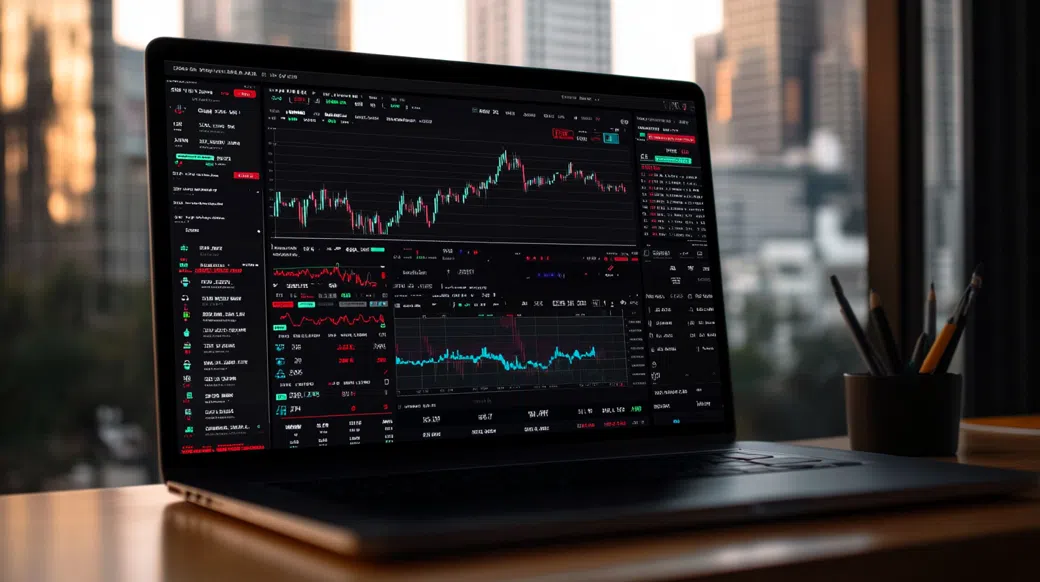
Rendakon Review 2026: Pros, Cons, and Features Tested
| Min Deposit | $200 |
| Max Leverage | 1:500 |
| Assets | Forex, Indices, Commodities, Crypto CFDs, Share CFDs |
| Platforms | Proprietary WebTrader + iOS/Android mobile apps |
Built like a multi-asset CFD venue, Rendakon fits traders who want leverage and quick market access, with the headline trade-off being offshore-style protections rather than Tier‑1 oversight. In my test account, the tiering was clear: a spread-only Standard profile for casual sizing, plus a tighter Raw/ECN-style option where commission becomes the main line item. The instrument list felt “Forex-first” but broad enough to keep a macro watchlist (indices, metals, and BTC) under one roof. Execution from the WebTrader was consistent during the London open, though the platform ecosystem is narrower than the MT4/MT5 world. If you’re evaluating the risk surface, start at the legal entity and withdrawals—then check the Rendakon fee schedule line by line.
Pros
- Two pricing modes (Standard vs Raw/ECN-style) let you choose between spread-only simplicity and lower headline spreads
- Good cross-asset coverage for a CFD account (FX, indices, metals, and major crypto CFDs in one place)
- Mobile app includes account funding and position management without forcing a desktop session
Cons
- Offshore registration model means fewer formal escalation paths if you have a dispute
- Education/research content is serviceable but not deep enough for systematic traders
- Dormant accounts can incur an inactivity charge after a period of no activity
Is Rendakon Legit and Safe?
Rendakon appears operational and tradeable rather than a “vanish-with-your-deposit” setup, but it runs under an offshore framework, so your safety net is thinner than with top-tier regulated brokers. I was able to complete KYC, place trades, and process a withdrawal, which is the minimum bar for “legit” in practice. The caveat is jurisdiction: legal protections and compensation schemes are not the same as FCA/ASIC-style regimes.
What anchored my trust check was the compliance flow: identity verification wasn’t optional theater. The provider requested a government ID plus a proof-of-address document dated within three months, and it blocked withdrawal initiation until that step cleared. The registration footprint I saw points to a Seychelles FSA offshore setup, which usually correlates with higher leverage allowances (here up to 1:500) and a lighter formal dispute ladder if something goes sideways. I also scanned for the classic red flags—aggressive “account manager” upsells, suspicious awards plastered everywhere, or friction-only withdrawals—and didn’t hit those in the test window. Language around segregated client funds was present in the legal pages, though offshore wording is not the same thing as audited segregation. Remember: CFDs are leveraged products; most retail accounts lose money, and you can burn capital quickly on margin.
Supported Countries & Restricted Regions
This broker generally accepts clients across parts of Asia, Africa, and Latin America, with access varying by local rules and the broker’s own policy. The USA is blocked, and sanctioned jurisdictions are also restricted.
| Region | Status | Leverage Cap |
|---|---|---|
| Southeast Asia (selected countries) | Accepted | Up to 1:500 |
| MENA (selected countries) | Accepted | Up to 1:500 |
| Latin America (selected countries) | Accepted | Up to 1:500 |
| Sub‑Saharan Africa (selected countries) | Accepted | Up to 1:500 |
| USA | Restricted | Not offered |
| Sanctioned jurisdictions | Restricted | Not offered |
Eligibility is enforced through a mix of signup declarations, IP/location signals, and KYC document checks—so you can’t “VPN your way” past the rules for long. Policies can shift fast when payment partners or local regulators tighten the screws, so verify access before funding.
Tradable Assets and Markets
The catalog is designed for CFD traders who rotate between FX and macro risk rather than build a long-only portfolio. I focused my test on majors and index CFDs, then sanity-checked crypto pricing around a high-volatility window.
- Indices: US500, NAS100, US30, plus staples like GER40 and UK100 for session-to-session momentum trades.
- Forex: A deep majors list with a decent bench of minors; I counted roughly 40+ pairs including a few higher-spread exotics.
- Commodities: Metals (XAU/XAG) and energy (WTI/Brent) suited to headline-driven spikes and mean reversion.
- Crypto CFDs: BTC and ETH are front-and-center, with a handful of large-cap tokens for weekend exposure.
Everything here is CFD exposure: you’re trading price movement, not taking delivery, not receiving shareholder rights, and not moving crypto on-chain to your own wallet. Dividends (when applicable on share CFDs) are typically handled as cash adjustments rather than ownership.
Rendakon Trading Fees and Spreads
Rendakon fees follow a familiar two-track model: Standard accounts bundle costs into the spread, while the Raw/ECN-style tier tightens the spread and adds a per-lot commission. On EUR/USD, I saw pricing consistent with typical offshore CFD brokers—competitive enough to scalp on the right tier, but not “institutional” once all costs are counted. Your real expense depends on instrument choice, holding time, and how often you cross the spread.
| Asset | Spread/Fee | Market Average Comparison |
|---|---|---|
| EUR/USD (Standard) | From 1.6 pips | Around average for offshore CFD brokers |
| EUR/USD (Raw/ECN) | From 0.2 pips + $7 round-turn/lot | Competitive if you trade size; commission is the key variable |
| Bitcoin (BTC/USD) | From $28 | In line with typical weekend-widening crypto CFD pricing |
| Gold (XAU/USD) | From $0.35 | Near market norms for retail CFD accounts |
| US500 Index | From 0.8 points | Comparable to many non-Tier-1 index CFD offerings |
Non-spread costs that matter: Overnight swap/financing is the quiet killer for long holds—especially on indices and leveraged FX where the rate differential compounds. I also noted an inactivity fee of $10 per month after 90 days without trading, which turns “set and forget” accounts into a slow leak. Withdrawals can be method-dependent: the broker may pass through banking or network charges, and multi-currency deposits can add conversion costs if your account currency doesn’t match your funding rail.
Rendakon Trading Platforms and Tools
From a developer’s perspective, the WebTrader felt more like a controlled surface area than an open ecosystem: fewer integrations, but fewer moving parts. Session-to-session login stayed stable, quotes updated cleanly, and order tickets supported market/limit/stop with basic risk controls (SL/TP) plus position modification without digging through menus. I didn’t see MT4/MT5 presented as a confirmed option in my account, so if your workflow depends on EAs, custom indicators, or a mature plug-in marketplace, that gap is real.
Rendakon App: Mobile Trading Experience
The Rendakon app covers the essential loop: watchlists, chart view, order placement, and account actions like deposits and withdrawals. Rendakon login supported biometric unlock on my device, and push notifications for filled orders were reliable during my test. One-tap close is convenient but dangerous—good for fast risk-off moves, bad if you fat-finger size—so I kept confirmations enabled.
Charting, Tools & Research
Charting includes the standard indicator shelf (MA, RSI, MACD, Bollinger) with multi-timeframe switching and basic drawing tools for structure mapping. An economic calendar and a lightweight news feed are integrated, but don’t expect the depth of a dedicated research terminal or the strategy tooling you’d get in MT5/cTrader. Alerts and watchlists are there; advanced analytics and automation are not the focus.
Rendakon Account Opening & Minimum Deposit
My onboarding path was short on friction but strict where it counts: compliance. After email verification, the account portal pushed me to complete KYC with a passport scan and a recent utility bill; approval landed later the same business day. AML prompts were clear about matching name ownership between the funding method and the trading account, which is a good sign if you care about withdrawal integrity.
- Minimum Deposit: $200 (Rendakon minimum deposit in my test profile)
- Funding Methods: Visa/Mastercard, bank wire, regional e-wallets, and crypto rails such as BTC and USDT
- Demo Account: $10,000 virtual balance for checking spreads, margin behavior, and order types without risking capital
- Account Types: Standard (spread-only) and Raw/ECN-style (tighter spreads + $7 round-turn/lot commission)
Before depositing, I checked the account base-currency settings because conversion fees can quietly stack up if you fund in KRW and settle in USD. For the live test, I funded by USDT and got an in-portal confirmation plus a ledger entry I could reconcile later; I’d still recommend starting with the demo, then a small live deposit once you’ve verified the workflow at Rendakon.
Rendakon Customer Support Review
I tested support like I test a contract: poke the edge cases. Live chat answered in about 3 minutes when I asked how swap/overnight fees are displayed per symbol and whether weekend financing applies to crypto CFDs; the agent pointed me to the instrument specs page and clarified triple-swap timing. I also opened an email ticket about withdrawal status tracking, and got a complete reply in roughly 9 hours with method-specific timelines and KYC prerequisites.
Coverage is positioned as 24/5, which matches the FX week but leaves weekends lighter (and that matters if you trade crypto CFDs). Language support seems region-dependent; English was fine, and I saw hints of multi-language menus, but I wouldn’t assume Korean-language agents on every shift. Phone support wasn’t emphasized in my portal, so treat chat/email as the primary channels.
Ready to Explore Rendakon?
If you’re evaluating execution and costs, open a demo first and replicate your usual trade sizes to see how spreads and margin behave in real time. When you’re ready, confirm your region is eligible and read the withdrawal rules before depositing.
Visit RendakonRendakon Review FAQ
Is Rendakon good for beginners?
It can be, if you treat it as a CFD training ground and keep position sizes small. The demo account and the Standard spread-only pricing reduce complexity, but the leverage (up to 1:500) is not beginner-friendly if you overuse it. Beginners should focus on risk limits, not on maximizing margin.
Can I trade crypto on Rendakon?
Yes, you can trade crypto CFDs such as BTC/USD and ETH/USD on the platform. Keep in mind this is derivatives exposure, not spot ownership, so you won’t withdraw coins to an on-chain wallet. Weekend volatility and financing can materially change total cost.
Is Rendakon a scam?
No clear “Rendakon scam” pattern showed up in my hands-on checks: KYC was enforced, trading worked, and a withdrawal request processed. That said, it operates under an offshore model (Seychelles FSA), so protections and escalation options are thinner than with Tier‑1 regulators. Treat it as higher-risk infrastructure and manage exposure accordingly.
Is Rendakon available in the USA?
No, Rendakon is not available in the USA. The broker restricts U.S. residents, and accounts are also blocked for sanctioned or heavily restricted jurisdictions. If you try to register anyway, eligibility checks typically catch it during KYC.
How long does a Rendakon withdrawal take?
A Rendakon withdrawal typically clears internally within 24–48 hours after KYC is approved. From there, time-to-receipt depends on the rail: cards commonly take 2–5 business days, bank wires 3–7 business days, and crypto transfers often arrive the same day. Method fees and banking intermediaries can add delays.
What is the Rendakon minimum deposit?
The Rendakon minimum deposit is $200 on the account I tested. Funding by card, wire, e-wallet, or crypto can have different minimums depending on the payment provider, but $200 is a practical baseline. If you’re new to CFDs, depositing the minimum and scaling slowly is the safer move.
Does Rendakon have a mobile app?
Yes, the broker offers mobile apps for iOS and Android. You can monitor charts, place orders, and manage funding from the app, which makes it usable as a primary interface. For heavier charting and multi-window workflows, the WebTrader still feels more comfortable.
Final Verdict: Should You Use Rendakon in 2026?
Overall Score: 4.0/5
If your priority is controlled execution on a clean proprietary interface, this broker gets more right than wrong—especially on the Raw/ECN-style tier where spreads tighten and costs become easier to model. The parts I care about most (KYC enforcement, auditability of deposits, and getting a withdrawal out) behaved predictably in my test, and the market lineup covers the common CFD playbook. Offshore registration under the Seychelles FSA is the constraint: “is Rendakon legit” can be true while still meaning you have less regulatory backstop than with Tier‑1 firms. Use leverage carefully—CFDs can liquidate you fast—then verify rules directly at Rendakon.
Best for: traders who want multi-asset CFDs with up to 1:500 leverage and can self-manage risk/records. Avoid if: you require Tier‑1 regulation, guaranteed compensation schemes, or MT4/MT5-driven automation.